An Empire of People
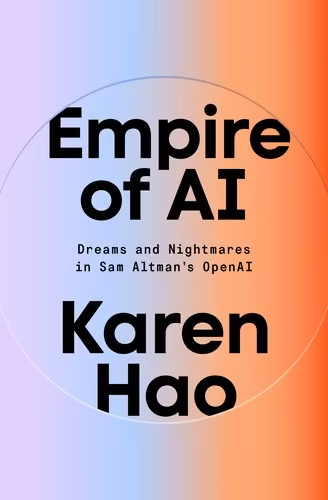
Karen Hao's Empire of AI tells the story of OpenAI through its people. Gripping as reporting, and uneven where it argues.
| Duration | 17 minute read |
|---|---|
| Published | |
| Review of | Empire of AI by Karen Hao (2025) |
| Rating | 7.5 / 10 |
| Topics | Research labs, Technology races, Hubris, Training data, Capital allocation, Bureaucracy |
In short
Karen Hao’s Empire of AI is an inside account of OpenAI, Sam Altman, and the people around them, built on some 300 interviews; I give it 7.5 out of 10. Read right after Sebastian Mallaby’s The Infinity Machine, it is almost a companion volume: the same cast and the same years, seen from OpenAI instead of DeepMind, with more politics and less technology. Its best material shows how OpenAI’s mission was redefined every year or two, which Hao reads as a formula for empire and I read as a process larger than any of the people in it. It is weaker where it argues: several chapters on the costs borne elsewhere could have been shorter, and its account of Chile reads the country through one political lens. Its lasting lesson is that a company of global significance is still run by people like you and me, a little smarter, more cunning, and more visionary.
Empire of AI opens on Friday, November 17, 2023, around noon Pacific time, when Sam Altman logs on to a video call and four of his five board members tell him he is fired. The prologue runs through all five days: the all-hands where Ilya Sutskever cannot explain anything, the threats from the executives, the employee letter, Microsoft’s offer, Sutskever’s change of heart, Altman’s return. Then the book goes back to a dinner at the Rosewood hotel in 2015, and only in its last part, from inside the board’s deliberations, does it reach the same five days again.
Karen Hao had followed OpenAI since 2019, when she spent three days embedded in its office and wrote the first profile of the company. The book rests on some 300 interviews with around 260 people, more than 90 of them current or former OpenAI staff, and on memos, emails, and Slack messages. Altman and OpenAI chose not to cooperate. It shows in both directions: she knows who said what in which meeting, and Altman is mostly seen through the people who worked with him.
I give it 7.5 out of 10. It is the book to read if you want to understand Sam Altman, OpenAI, and the feuds that shaped both, and it convinced me of something I had suspected: a company that may matter as much as any company in history is still run by people like you and me, a little smarter, a little more cunning, and a little more visionary.
Two books, one story
I read it right after Sebastian Mallaby’s biography of Demis Hassabis, The Infinity Machine, and that turned out to be the right order. Mallaby tells the genesis of DeepMind and, along the way, the genesis of modern machine learning, in chronological order, up to the transformer-based language models whose consequences we are only beginning to live through. Hao tells the other half: the same years, many of the same people (Musk, Sutskever, Amodei, Hinton, Suleyman), seen from San Francisco instead of from London. The two books mirror each other’s blind spots. Mallaby had Hassabis’s cooperation and drew Altman through his rivals; Hao had no cooperation from Altman and draws Hassabis, when he appears at all, from a distance.
Some scenes appear in both and are better for it. Musk’s fear of Hassabis, which Mallaby reports from London, is in Hao’s first chapter as the reason OpenAI exists at all: Musk wanted the future of AI not to be controlled by Larry Page, and Altman emailed him that it would be good for someone other than Google to build it first. A former DeepMind researcher tells Hao that OpenAI’s founding was “a semi-hysterical reaction to a fairly mild-mannered man.” And where Mallaby shows DeepMind dismissing language as the road to intelligence, Hao shows the memo that changed its mind: Geoffrey Irving, a safety researcher who left OpenAI for DeepMind in 2019, brought with him the case for scaling language models (chapter 7). I drew the people and ideas that both books cover, with a source for every link, in Who contributed to AI.
The difference in emphasis is large. Mallaby explains the technology, twice for every idea, and the people serve the history of the field. Hao is interested in the people and the politics, and in who pays for the technology rather than how it works. Both are legitimate choices. Hers makes the better thriller and the weaker history of ideas.
How it is told
Hao writes for suspense, and I appreciated it. These stories are so intertwined, and so interesting on a human level, that they deserve to be told as a drama: the Rosewood dinner, Musk’s ultimatum and exit in 2018, Bill Gates being won over by a demo of GPT-2 and then by GPT-4 passing his biology exam, the Amodei siblings leaving with a third of the GPT-3 team to found Anthropic, and ChatGPT itself. It was rushed out in November 2022 on a rumour that Anthropic was about to ship a chatbot, framed internally as a “low-key research preview”, and staff placed bets on whether a few thousand or tens of thousands of people would try it over the weekend. It had a million users in five days.
The structure is less kind to the reader. The book is in four parts and broadly in order, but it tells several stretches twice. Chapters 2 and 3 tell the years from 2015 to 2019 as the story of an institution, and chapter 5 goes back and tells them again as the story of the research. Chapter 4 leaves OpenAI entirely for an essay on the history of AI from the cotton gin to Dartmouth to deep learning. Chapter 9 moves between Kenya in 2021, Venezuela’s collapse, Colombia, and Nairobi in 2023. Chapter 13 takes up 2023 again from the side of Washington. After Mallaby’s strictly chronological account I sometimes lost track of where in the timeline I was. It did not stop me reading, but a timeline or a list of the cast at the back would have helped, and the book has neither.
The bet on language
Some of the best material is in chapter 5, on the decisions that made GPT. Hao reports that Ilya Sutskever’s framing inside OpenAI was “Intelligence is compression”: a model trained to generate convincing text has to compress what it learns about the world into its essence. Dario Amodei then runs research as a portfolio of bets, and the bet he keeps is GPT-2, which stood for what the field called the “pure language” hypothesis: that a system trained on enough text and nothing else could become generally intelligent, against the “grounding” hypothesis that it would also need perception and action. Amodei came to see scaling language models as perhaps the fastest path, though likely not the only thing needed.
Put next to Mallaby, this is the decisive fork of the decade. DeepMind’s business plan of 2010 dismissed the idea that language is intelligence expressed, and Hassabis spent years believing a model had to act in the world to understand it. OpenAI bet the other way, and won the first round. That compression and pure language are two halves of one wager, that text is enough, is my reading, not Hao’s. She calls the arguments some staff made for the language bet, by analogy to Helen Keller and blind people, “repugnant”, and in chapter 4 she argues that scaling is “a self-fulfilling prophecy”, not a natural law. The book shows the fork clearly anyway.
Three other passages from the first half became notes of their own: a Chinese researcher’s view that no one outside Silicon Valley would have funded this before it had a use (A billion without a plan), the Rickover quote Altman had painted on the office walls (One person can make a difference), and the film Her as OpenAI’s picture of what AGI should feel like (The interface that disappears).
How a mission moves
The passage I will remember longest is in chapter 18, “A Formula for Empire”. Hao argues that OpenAI’s mission works as a formula with three ingredients: it gathers talent around a grand ambition, it gathers capital by making the alternative look dangerous, and it is vague enough to be reinterpreted whenever that suits the company. As evidence for the third, she lists what the mission was said to mean at each stage, each time in the company’s own words:
| Year | What the mission was said to mean | Where it was said |
|---|---|---|
| 2015 | A nonprofit “unconstrained by a need to generate financial return”, open-sourcing its research | The launch announcement |
| 2016 | Everyone should benefit from AI once it is built, but the science need not be shared | Sutskever, in an email to Altman, Brockman, and Musk |
| 2018 to 2019 | A capped-profit structure to raise the resources the work needed, while avoiding a race without time for safety | The charter |
| 2020 | The model walled off behind an API, as “a strategy for openness and benefit sharing” | Altman, replying to Hao’s first profile of the company |
| 2022 | “Iterative deployment”, and racing to ship ChatGPT | Hao’s summary of the company’s line |
| 2024 | Putting very capable AI tools in people’s hands for free, or at a great price | Altman’s blog, after GPT-4o |
The chapter opens with Altman praising a book of Napoleon’s sayings, in particular how Napoleon reinterpreted the motto of the revolution to consolidate his own power. The parallel is pointed, and Hao means it to be. I read the table differently. Every step has a reason that made sense at the time: training runs got expensive, so the nonprofit needed capital; capital needed a return, so the model needed a business; competitors appeared, so the business needed speed. The idealism of 2015 was not abandoned by one decision. It was worn down by the realities of compute, money, and competition, one reasonable step at a time, by people who mostly still believed they were serving it. That is a process larger than any single person in it, Altman included, and I suspect it would have happened under any of the founders.
The same process shows in a smaller story in chapter 11. In a 2020 memo Altman wanted OpenAI to stay “small, focused, high-trust, low-bullshit, and intense”, and in late 2022 he argued for no more than about a hundred new hires while other executives wanted five times that. OpenAI had about 300 people at an off-site in October 2022 and was close to 800 a year later. Every large group ends up spending more of its work on holding itself together, in a ministry as in a corporation, and I wrote down my own version of that observation in Small, focused, high-trust.
Where I part ways
Hao writes from a clear position, and she says so in the author’s note: the book is “not a corporate book” but “a meditation on power”, and she embedded with communities around the world who live with AI’s costs. In the prologue she states the metaphor plainly. The AI companies are empires in the colonial sense: they seize resources that are not their own, exploit the labour of others, and justify it with ideas of modernity and a race against rival empires. That makes for honest reporting, and in places it makes for a book that reads as a case against the people building AI rather than an account of them. Some of the chapters on the costs borne elsewhere felt longer than their point, and could have been condensed.
One of them I would not cut. Chapter 7, “Science in Captivity”, follows Timnit Gebru, an Ethiopia-born researcher who came to the United States as an Eritrean refugee in her teens and co-led Google’s ethical AI team. She had co-authored “Gender Shades” with Joy Buolamwini, which showed that commercial face analysis failed most often on darker-skinned women. When GPT-3 arrived she warned that a model trained on Reddit and the rest of Common Crawl would absorb its toxicity, and with Emily M. Bender she wrote “On the Dangers of Stochastic Parrots”. Google ordered her to retract the paper. She set conditions and said she would leave if they were not met; on December 2, 2020, Google told her it was accepting her resignation immediately, and she announced that she had been fired. Hao’s larger point is about science: after this, and after ChatGPT, the industry stopped publishing what its models were trained on, and you cannot test a model honestly if you cannot see its training data. I remembered the debate from the early days of GPT, when bias in the weights was what everyone talked about. In my own work that problem has receded since: a model that looks facts up with tools before it answers gets them right far more often than one answering from its weights. That is not the same as having no bias in the weights, but it changed how much it matters. Hao’s point about closed training data stands either way.
The chapter on Chile, “Plundered Earth” (chapter 12), I found hard to read. Hao tells Chile’s story through its colonial past, the Chicago Boys, Pinochet’s privatisations, inequality, and the election of Gabriel Boric, and she places it among the countries of the Global South that supply the empire with copper, lithium, land, and water for data centres around Santiago. I am fond of Chile and know people there, and that is one lens on the country, not the whole of it. Chile ranks highest in Latin America on the UN’s Human Development Index. Its government courts data centres because it wants the investment, and Hao’s own reporting shows a country deciding for itself: a referendum in Cerrillos, an environmental court that in 2024 ruled Google could not build a water-cooled data centre in Santiago, and a ministry that now drafts its data centre strategy with the activists at the table. By global standards Chile is a sensible place for data centres and mines, and water in a long drought is a fair concern. Hao’s sources are more careful than her framing here. The Indigenous activist Sonia Ramos says her ancestors were miners and the problem is the scale; the Uruguayan researcher Daniel Pena says the same of data centres.
Scale is exactly where I part ways. The bet that Altman, Hassabis, and others make is that spending the world’s resources on building more intelligence will repay itself, by solving problems that we cannot solve without it. Energy is the largest of them. Hao reports that Altman liked to say the energy problem of his largest data centres would solve itself with a breakthrough in nuclear fusion, and that Helion, a fusion company, is his largest personal investment. She quotes a researcher who calls the claim that AGI will solve our environmental problems impossible to prove. It is. It may also be wrong. But it is a coherent strategy, and it deserves more sympathy than the book gives it. Empires are not a net negative by definition. Power concentrated in a few hands makes harm possible, and that is worth debating; the question is what is done with the power once it is accumulated, not the accumulation itself. I made a version of this argument about capital in A billion without a plan.
How the empire falls
The epilogue gives Hao’s alternative. Te Hiku Media, a Māori radio station in the far north of New Zealand, built the first speech-recognition model for te reo Māori from 310 hours of recordings that the community donated with consent, trained on two GPUs of its own. Hao sets it against OpenAI’s Whisper, trained on 680,000 hours taken from the web. Then, borrowing from a talk by the Stanford researcher Ria Kalluri, she names three axes of power: knowledge, resources, and influence. In her account the AI companies control knowledge by concentrating talent, eroding open science, and sealing their models from scrutiny; they control resources by gathering funding, data, labour, compute, energy, and land; and they control influence through ideology and demonstrations that capture the world’s imagination. Her remedy for the third is public education, and she ends with Joseph Weizenbaum, the creator of ELIZA, on what happens once a program’s workings are explained plainly enough to be understood: “its magic crumbles away.”
The axes are a useful lens, and I will use them. Te Hiku is a good story, and small models trained on data people chose to give are part of the future. The detail I find most important is easy to miss: Te Hiku bought its own GPUs, so it did not depend on any tech giant’s cloud. Ownership of the hardware is the part of the resources axis that ordinary people can actually change.
Training bespoke models is one way to do that. Running them is the other, and it is where more and more of the compute goes, every time someone asks a model anything. That is the problem I work on with Archipelag.io: a network in which AI jobs run on GPUs operated by people and communities rather than by a handful of hyperscalers, preferring hosts nearby and recording where every job ran. It is in open beta, and it will not train the next frontier model. But it lets people own a piece of the infrastructure that runs AI instead of only renting access to it, with what comes with ownership: income for the people who host, data that stays closer to home, and no single landlord who can change the terms. The web did the same for publishing. Before it, reaching an audience took a printing press or a broadcast licence; after it, anyone with a computer could put up a page, and the web grew out of millions of people doing exactly that, as I wrote in my review of Tim Berners-Lee’s memoir. Distributed citizen compute is the same move for inference.
I agree completely with the remedy: explaining how these systems work is the best thing anyone can do, and it is what this site tries to do. I part ways where the diagnosis treats concentration itself as the problem, and where small models are offered as a replacement for the large ones rather than as their complement.
Who should read it
Anyone interested in Sam Altman, OpenAI, and the people and feuds behind the technology, ideally after The Infinity Machine, which explains the technology Hao mostly takes as given. The detail is extraordinary, and I came away with more trivia worth remembering than from most books this year. I wish it had stayed more focused: with Hao’s access to the people around Altman, a tighter book about the people alone would have been even grander.
What stays with me is a thread Hao pulls as criticism. The book opens with two epigraphs: Weizenbaum on magic that crumbles once it is explained, and a line from Altman’s blog. In chapter 10 she writes that the Doomers and the Boomers preach from the same bible, one of hellfire and one of heaven. In chapter 18 she comes back to that line of Altman’s, from 2013: the most successful founders set out to create “something closer to a religion”, and a company turns out to be the easiest way to do it. And in chapter 17 she quotes him on a podcast saying that “intelligence is just this emergent property of matter”, which she offers as hype. I share that conviction, and I wrote about it in An emergent property of matter. Where Hao sees a religion as a warning sign, I see an honest description of what these companies are becoming. As the value of human labour falls, they will be held together less by the work they pay for and more by what they believe. OpenAI is one of the first, and its mission will keep moving.