The Phrase That Stayed
I kept one phrase from Taleb's Skin in the Game. Now that code is cheap, I think it names what is left: someone who owns the outcome.
| Duration | 11 minute read |
|---|---|
| Published | |
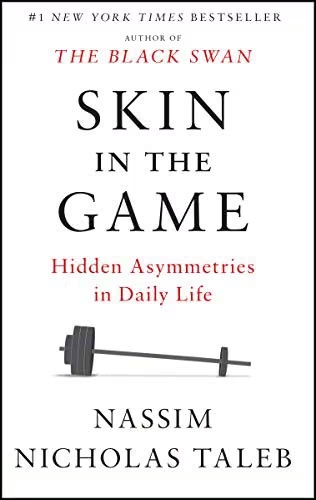
| Review of | Skin in the Game by Nassim Nicholas Taleb (2018) |
| Rating | 8.5 / 10 |
| Reading | The Black Swan by Nassim Nicholas Taleb (2007); Antifragile by Nassim Nicholas Taleb (2012) |
| Topics | Risk, Ethics, Trust, Entrepreneurship, Future of work, Agents, Post-scarcity |
In short
Nassim Nicholas Taleb’s Skin in the Game argues that whoever makes a decision should carry its consequences, and that systems where they do not slowly break; I give it 8.5 out of 10. I read it in 2022 and remember few of its details, but its title entered my everyday vocabulary, which says more about a book than most reviews can. Going back to it, I found that I use the phrase more generously than Taleb does: for him it is first about symmetry and downside, for me about ownership and daring. Taleb has a word for my use too, “soul in the game”, and the book’s strongest pages are about courage, the one virtue he says you cannot fake. Now that agents make code cheap, I think the phrase names what is left: ownership, trust, and the ability to execute, carried by someone who answers for the outcome.
I read Skin in the Game in 2022, after The Black Swan and Antifragile, and I will be honest about what is left of it four years later. I could not tell you the order of its chapters or retell most of its stories. What I kept is the phrase. I say “skin in the game” all the time now, at work and outside it, whenever I mean that someone should feel responsible for a thing, own it, dare something, and put enough of themselves into it that it can make the world a little better. If everyone had some skin in the game, I think we would all live in a more engaged world.
That is a strange thing to review, so this is a review of what a book leaves behind. I went back to the text to check whether the phrase I use is the one Taleb meant. It mostly is, but the book is harder than the phrase, and in places better.
I give it 8.5 out of 10. Few books have changed how I talk as much as this one, and it gets more relevant every year that agents take on more of the work.
What Taleb means
The book is the fourth volume of what Taleb calls the Incerto, after Fooled by Randomness, The Black Swan, and Antifragile, and it states its claim early: “skin in the game is necessary for fairness, commercial efficiency, and risk management: skin in the game is necessary to understand the world.” The core is symmetry. Whoever takes a risk should carry its downside, and whoever gains from a decision should be exposed to it when it goes wrong.
He starts, as I remembered, with Hammurabi. The code on the basalt stele in the Louvre, some 3,800 years old, opens its best known rule with “If a builder builds a house and the house collapses and causes the death of the owner of the house”, and the builder pays with his life. Taleb’s point is not the cruelty but the design. The builder knows more about the house than anyone, and the best place to hide a flaw is in the corners only the builder can see. The law makes the builder’s fate depend on what is in those corners. I used that passage before, in The Original Data Company, because insurers live on exactly this problem.
The counterexample is what he calls the Bob Rubin trade. Robert Rubin, a former US Treasury Secretary, “collected more than $120 million in compensation from Citibank in the decade preceding the banking crash of 2008,” and when the bank had to be rescued, “he didn’t write any check.” The upside was private; the downside went to everyone else. From there Taleb draws the sentence about institutions I quote most after the title: “Bureaucracy is a construction by which a person is conveniently separated from the consequences of his or her actions.” (More on that in a note.)
The parts I had forgotten
Rereading, I was surprised how much of the book is not about bankers at all.
Chapter 2, “The Most Intolerant Wins”, argues that a small, stubborn minority, three or four percent of a population, can impose its preferences on everyone if the rule is asymmetric: someone who keeps kosher will not drink non-kosher lemonade, but nobody else minds drinking kosher, so producers and grocers simply make all of it kosher rather than keep two supplies. It is one of the most useful ideas in the book and has little to do with risk in the narrow sense; I applied it to software standards in The most intolerant wins.
Chapter 8 introduces Lindy, named after a New York deli where actors noticed that Broadway shows that had lasted a hundred days could expect a hundred more. Taleb turns it into a rule for anything that does not age: “the only effective judge of things is time”, which is a better test for a framework, a book, or a protocol than any review, this one included. I use it for choosing technology, in Lindy for software.
Chapter 19, “The Logic of Risk Taking”, which Taleb calls the central chapter and puts last, is the one I would send to an engineer. Its argument is about ruin: an average over many people is not the same as the path of one person over time, and a strategy that is rational on paper is irrational if one bad outcome ends the game. “Rationality is avoidance of systemic ruin,” he writes. That is the same idea that runs through The Black Swan and Antifragile, now with a name for the person who has to live with it, and it is the rule I use for gating agents in Rationality is avoidance of ruin.
And there is the tone. Taleb is combative, repeats himself, and has a long chapter on the “Intellectual Yet Idiot” that reads like a settling of scores. Some of the book is more fun to have read than to read. I do not hold that against it; it is part of how the ideas stay with you.
Soul in the game
The surprise was that my own use of the phrase is in the book too, under a different name. Taleb writes of people with “skin in the game (or, better, soul in the game),” and he uses it for something beyond exposure to loss: doing a thing because you care about it, with no one forcing the symmetry. He tells how he learned enough Akkadian to recite Hammurabi’s law in its own sounds, because talking about the stele without being able to read it felt like cheating. He notes that Microsoft, Apple, Facebook, and Google “were started by people with skin and soul in the game.” And in chapter 13 he writes the line I wish I had remembered: “Courage is the only virtue you cannot fake.” It got a note of its own.
That is where I land. Taleb’s version is mostly negative: remove those who can harm others without being harmed. Mine is mostly positive: the people who carry things forward are the ones who put themselves into them, which is what I argued in Who carries progress and saw in a friend’s idea factory. Taleb says the two belong together. The introduction calls skin in the game “mostly about justice, honor, and sacrifice,” and the glossary is blunt: “virtue devoid of courage, sacrifice, and skin in the game is never virtue.” The penalty and the engagement are one idea seen from two sides.
What is left when code is cheap
The reason the phrase matters more to me now than in 2022 is the question everyone in my field is asking since agents started writing software: if code is cheap, what is left? My answer is Taleb’s. Ownership.
Ideas were always cheap. Everyone has one, the way everyone has an opinion, and an idea nobody acts on is worth nothing. Code used to be the expensive part. It took years to learn, it was hard to hire, and harder still to scale a team without losing quality: Fred Brooks put it in The Mythical Man-Month in 1975 as “Adding manpower to a late software project makes it later.” That constraint is going away. One person with a fleet of agents can now produce what a department produced, and at the Agentic Engineering Days in Zurich this month the slide that got the room was Krzysztof Cieślak’s “Code is cheap. Shared understanding and trust aren’t” (I wrote about it in The Constraint Moves).
What does not get cheaper is someone with a vision, the endurance to stay loyal to it for years, and the willingness to answer for it. When I choose a product or a service, I am not buying its code. I am buying the knowledge that somebody will keep delivering it next year, and that this somebody will pay, in reputation and if need be in court, when it fails. That is skin in the game in the most ordinary sense, and it is the one thing an agent cannot supply on its own behalf.
Taleb saw half of this coming, from the other side. Chapter 3, “How to Legally Own Another Person”, is about why companies prefer employees to contractors, and his answer is that employees have something to lose: “employees have a reputation to protect.” A firm, in his account, holds its people through their dependence and their reputation, and that is what makes them reliable. An AI agent is the perfect employee in every respect but this one. It has no reputation, no career, nothing to lose. So all of the exposure that used to be spread across a team now flows to the person at the top, as I wrote in The perfect employee has nothing to lose. Whoever runs a thousand agents owns everything they do, in Taleb’s full sense of the word, because there is nobody left below to share it.
That changes what a builder is. The scarce person is no longer the one who can write the code but the one who can be trusted with the outcome: who will be there in five years, who has staked a name on the thing, who has, as Taleb puts it in the introduction, something in the portfolio rather than an opinion: “Don’t tell me what you ‘think,’ just tell me what’s in your portfolio.” Lindy applies here too. A product that has been run well by the same owner for a decade carries more trust than any feature list, because time is the judge that cannot be argued with. In my own work this is the design principle behind every agent platform I build: each action traceable to a person who answers for it, each agent with a human sponsor whose name is on the line. In Hammurabi’s terms, it puts the builder back under the house.
The last owners
I take this one step further than Taleb would. I believe that ownership, trust, and the ability to execute are what remain after AI and robotics have taken over most human labour. If we reach a society of abundance, fully automated, where material and social needs are provided for, it will still need a small group of people who oversee the machines: who decide how energy and resources are allocated, and who keep the whole system running. The ultimate engineer-operator.
The book gives two warnings for that world, and I think they are the right ones. The first is chapter 2: a small minority with soul in the game sets the rules for everyone else, whether or not anyone notices. A tiny group of operators will shape a society the way three percent of kosher drinkers shape the lemonade aisle, so it matters a great deal who they are and what they care about. The second is the oldest rule in the book. The fewer people stand between a decision and its consequences, the more those few must carry them. Bureaucracy, in Taleb’s definition, separates people from the consequences of their actions; a fully automated society would be the largest bureaucracy ever built, unless the people at the top live under the house they built. If there are last owners, they need the most skin in the game of anyone, not the least.
Who should read it
Anyone who has to decide who gets to decide: managers, founders, people who design institutions or systems. Read The Black Swan and Antifragile first if you can; this is the book where their ideas turn into ethics. Skip around if a chapter loses you, and do not skip chapter 19.
I kept one phrase from it for four years and used it more than almost any other idea I have read. That is the best test of a book I know, and Taleb would call it Lindy.
References
- Nassim Nicholas Taleb, Skin in the Game: Hidden Asymmetries in Daily Life, Penguin, 2018
- Fred Brooks, The Mythical Man-Month, 1975, via Brooks’s law
- Krzysztof Cieślak, closing slide of his talk at Agentic Engineering Days Zurich 2026, in The Constraint Moves